
Performance Products
Official HEL Performance online sales of oil cooler kits & oil line kits
See our online store or e-mail us
Oil Cooling - How much energy does an engine produce?
We all know that the internal combustion engine is not as efficient as it could be. It loses energy through friction and heat loss. But what most people are unaware of is how much energy is lost as heat and how much more heat is created from the same engine once it has been tuned... The potential energy which goes in through the carburettors of a mild road going four stroke 750CC four cylinder engine is about 350bhp - Yet the amount of power it actually produces is approximately 3oobhp - Real power is generally 25 - 30% of potential. The rest goes in overcoming friction of the moving parts, pumping air in, out and around the engine, exiting through the exhaust and in heat loss.
In fact more than 30% of the potential power is wasted as heat energy - more than is produced as usable power...
Oil Cooling - Why doesn't the engine melt?
Why doesn't the engine melt? Where does all the heat go ? It goes into the oil, the body of the engine and into the oil cooler. And if the bike doe not have a cooler? - Well if it has enough fins and a massive amount of air to cool everything it may be okay otherwise expect short engine life, seizure, breakdown of the oil...
Engine oil works best between 70°C and 80°C although it's generally safe up to 100°C. Oil stops doing it's job when it gets too hot. So you can now see the importance of fitting an oil cooler to your bike to improve cooling efficiency and improve power. Take a look at any racing bike - the OEM cooler has been removed and replaced with a larger more efficient oil cooler to maximise power...
the perfect team for
engine cooling performance
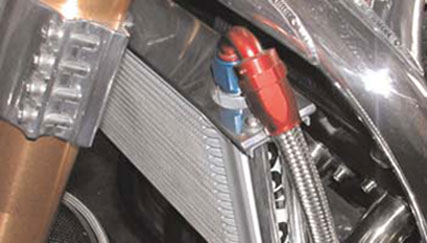
Our oil coolers have earned a reputation for being a lightweight, highly efficient heat transfer product combined with durability and reliability. Oil coolers manufactured utilising aluminium alloy components, brazed into one piece assemblies. The brazing process combined with appropriate design features ensures a product capable of withstanding tests up to 350psi. Please remember that if you rev the engine without allowing the oil to reach it's optimum operating temperature or if your engine has a sticky by-pass valve then a spike or instantaneous pressure pulse can occur through the cooler which far exceeds 350psi.
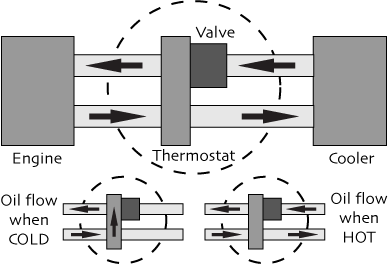
Any engine should be left to tick over until oil temperature is at it's optimum, but for certain applications you could fit a thermostat and check valve as shown here.
The reasons for fitting a cooler are easy to see. When racing or placing unusual demands on an engine or tuning an engine, oil can heat up over safe limits. The result could be reduced engine life. For every 10° of excessive heat, oil life is halved and in severe cases can warp blocks, rupture radiator hoses and burn valves.
Mounting Instructions for HEL Performance Oil Line Kits.
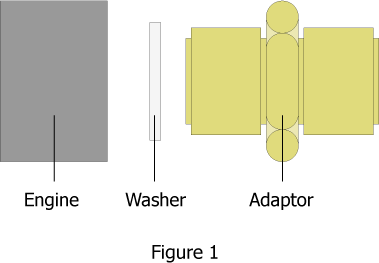
There are several different varieties of oil line kits we currently supply. On some occasions adaptors may be required and these will be included in your kit with the appropriate washers. These washers will be fitted between the adaptor and the cooler or the adaptor and the engine block as shown in Figure 1 below.
Please contact us for information regarding brake line kits and clutch line kits for your bike.
